When Kansas City families learn civics together, democracy gets a boost | Opinion
Below is the OpEd as written by Dr. Joanna Geller and Dr. Julie Holland. Dr. Geller is the director of policy, research and evaluation at NYU’s Metropolitan Center for Research on Equity and the Transformation of Schools. Dr. Holland is the founder and director of the Parent Leadership Training Institute in Kansas City.
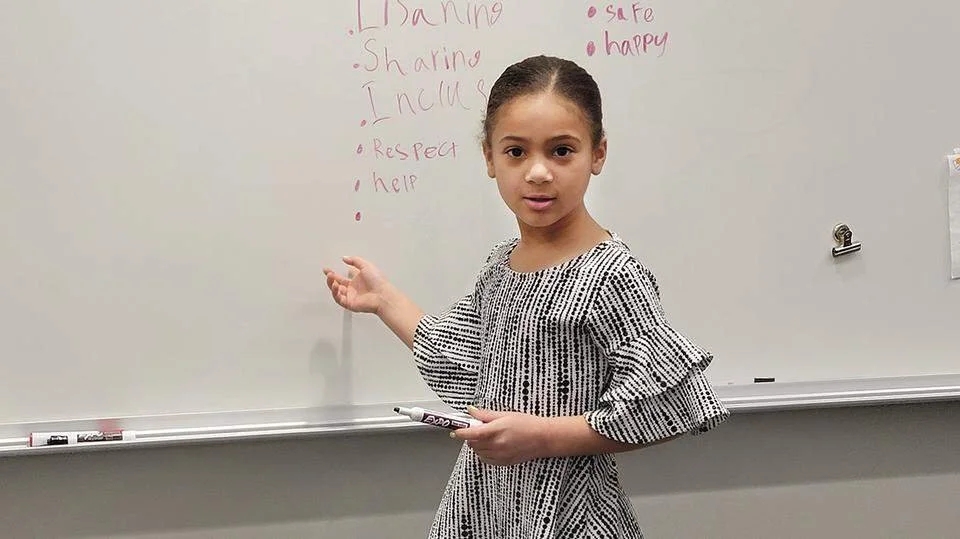
CLTI leader and KC second-grader Cora.
In a sunlit classroom in Kansas City, second-grader Cora stood confidently at the front of the room, dry-erase marker in hand. “I want to write down the thoughts,” she said, leading her peers in the Kindness Crew, a student-led initiative she co-created with her mom, Abigail Whitney.
Designed for first-, second- and third-grade students, the project builds a school culture rooted in empathy, emotional intelligence, inclusion and self-determination — lessons Cora learned through CLTI, the Children’s Leadership Training Institute, and PLTI, the Parent Leadership Training Institute, a national initiative with a site in Kansas City.
The experiences of Cora and other Kansas City students illustrate a powerful truth: When families engage in civic learning, children see themselves as capable change-makers — and so do their parents.
Across the U.S., young people are skeptical about democracy. Only 16% of U.S. young adults age 18-29 believe democracy is working well for people like them. Nearly 4 in 10 children and teens say their voice doesn’t matter at all in government.
Yet, when we look closely at young people who do believe their voices matter and who are engaged civically, a consistent influence rises to the top: their families.
Decades of research point to the same conclusion. When parents and caregivers model civic participation and talk openly about social issues, their children are far more likely to be adults who vote, volunteer, campaign for causes they care about and work with others to improve their communities.
Unfortunately, school- and community-based civic initiatives typically overlook families, missing one of the most powerful levers for lasting impact.
CLTI and PLTI are exceptions — in Kansas City and across the nation. Parents and children age 3-12 participate in parallel programs over 20 weeks, building skills in public speaking, understanding community systems, navigating government and shaping public policy.
Families then translate those skills into action, just like Abigail and Cora did with Kindness Crew.
For Abigail, the project created intentional space for shared leadership and connection, reinforcing that civic engagement isn’t something children grow into someday — it’s something families can practice together now. Abigail shared that as a busy working mom, this has been an opportunity to bond with her daughter on something positive that will ripple through the school.
Children, parents see selves as change-makers
A national study of CLTI and PLTI by the New York University Metro Center shows what’s possible when civic learning moves into the family. Participating families become more civically confident and talk more often about community issues. Children develop lasting feelings of leadership and agency. Parents, many of whom previously felt powerless, begin to see themselves as capable change-makers.
This shift happens in part through a process of “family civics” — when parents and children actively apply what they learn at home. Parents and children strategize together about how to solve problems that before seemed intractable, such as bullying or unhealthy school lunches. With the belief that their voices are powerful, they apply their new knowledge and skills to these problems: whom to contact, how to build support and how to communicate effectively. Civics becomes part of daily family life.
The ripple effects extend even further: Siblings and spouses also become more engaged, and families report stronger relationships with better listening, patience, and collaboration.
As the country celebrates National Civic Learning Week March 9-13, we should think about what this means for civic education more broadly. If we want civic learning to be effective and durable, families can’t be an afterthought. At a minimum, schools should help families extend civic learning beyond the classroom by sharing what students are learning and offering questions to spark conversation at home. Better still, schools can host family civic workshops or design service-learning projects that bring families together around real community issues.
With greater investment, community organizations that currently serve only youth or only parents can intentionally build intergenerational civic experiences. At a moment when faith in democracy is fragile, Kansas City families like Cora and Abigail show us what’s possible when civic learning moves beyond the classroom and puts families front and center.